
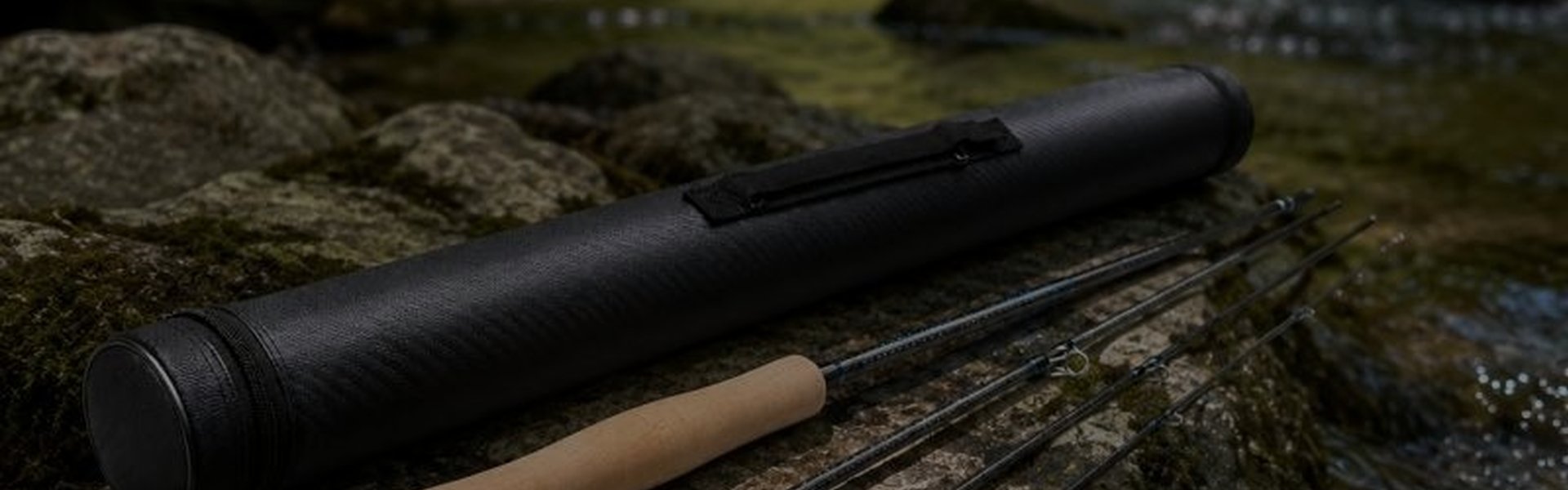
Custom rod development is the route for buyers who have a defined rod in mind rather than a rod to re-brand. It covers the work between a written brief and an approved sample: specifying the blank, developing taper and action, matching components, iterating prototypes, agreeing tests, and keeping drawings and specifications under control. This page sets out that scope and the way we run it, so you can judge whether your project belongs here or in one of the lighter modes described under Private Label Fishing Rods.
What a development project includes
- Blank specification. Length, number of sections, joint type, target power and action, line and lure ratings, material preference and any transport length limit are written into a specification sheet. Where you supply a reference rod, we measure and record it as the starting point.
- Taper and action development. The blank design is developed toward the specified action and power. Changes between iterations are recorded so that the final blank can be reproduced. Bulk supply of a developed blank through Fishing Rod Blanks can be discussed if you assemble elsewhere.
- Component matching. Guide train, tip-top, reel seat, handle and butt components are chosen to suit the blank and the fishing application. Our own carbon fiber guides, titanium guides and carbon fiber reel seats are available directly; other brands and materials are sourced to your specification.
- Prototype iteration. Prototypes are built, reviewed against the brief and revised. Each round is documented with what changed and why.
- Testing. The checks performed on prototypes and on the approved sample are agreed with you in advance, so that both sides accept the same criteria.
- Drawing and specification management. The approved drawing, specification sheet and bill of materials are revision-controlled and become the reference for bulk production.
What we need from you
- The fishing application and target market, including the retail positioning of the rod.
- Target length, sections, power, action and ratings, or a reference rod you want to improve on.
- Any components that are fixed in advance, such as a reel seat brand or a guide series.
- Branding requirements that affect the build, such as logo position or color.
- Planned quantities and launch timing, so that development is scheduled realistically.
Incomplete briefs are not a barrier. We review what you have and return a list of open points before any development work starts.
How development moves to production
Development ends when a sample is approved by both sides. From that point the project follows the same route as any other OEM program: pre-production confirmation, bulk production, inspection, packaging and shipment. The steps are described in the OEM Production Process, and the approval method in Sample Development. Bulk rods are inspected against the approved sample as described on Quality & Inspection.
Scope and limits
We describe development as a scope of work and a method, not as a list of finished projects. Performance statements about a developed rod, such as weight, sensitivity or strength, are made only when supported by tests agreed within the project. Where a feature you want depends on a sourced component, its availability and lead time are confirmed with the supplier before we commit to it in the specification.
When development is the wrong tool
If your goal is a branded version of an existing rod, catalog-based private label is faster and less costly. If you want to change components on a proven blank, platform customization is usually enough. Both are explained on Private Label Fishing Rods, and the overall offer for complete rods is on OEM Fishing Rods. If you only need a guide system specified for an existing rod, start from Fishing Rod Guides.
Start a development brief
Send your specification, reference rod details or even a sketch through Request a Quote. We will confirm the scope, the information still missing and the proposed sequence of samples before quoting.