
For established fishing tackle brands, importers, and wholesalers, finding a new supplier usually does not mean starting from zero.
Most experienced buyers already work with one or more suppliers. They look for alternatives because there may be opportunities to improve the existing supplier network, such as:
- More competitive purchasing costs
- Better quality or batch consistency
- More reliable production lead times
- More suitable MOQ structures
- Stronger product development capabilities
- Better expertise in a specific product category
- Additional production capacity
- Reduced dependence on a single supplier
- A reliable second source or backup supplier
- Better allocation of different products across specialized suppliers
Therefore, the real question when evaluating a new fishing tackle supplier is not simply:
“Is this a good supplier?”
A more useful question is:
“What can this supplier improve compared with the suppliers we already use?”
The final decision does not always have to be a complete supplier replacement.
For an established buyer, there are usually three possible outcomes:
Replace – Add – Keep
The objective is to reach that decision through a controlled evaluation process rather than shifting significant purchasing volume because of a lower quotation or one successful sample.
1. Define Why You Are Looking for a New Supplier
Before approaching alternative suppliers, identify what you actually want to improve.
Without a clear objective, it becomes difficult to evaluate whether a new supplier offers meaningful value.
Reduce Purchasing Cost
A mature product may have been sourced from the same supplier for years, making it reasonable to benchmark current purchasing costs against the market.
However, a lower quotation should be based on the same-or an acceptable equivalent-product specification.
If the lower price comes from downgrading gears, bearings, guides, hooks, materials, packaging, or other important components, this is not necessarily a true purchasing-cost improvement.
Improve Quality Consistency
Sometimes the approved samples are good, but problems appear during mass production:
- Cosmetic variation
- Assembly variation
- Component changes
- Performance variation
- Packaging errors
In this situation, one of the main evaluation criteria for a new supplier should be:
Batch consistency
A perfect sample alone does not solve the original problem.
Improve Production Lead Time
If an existing supplier frequently fails to meet the agreed production schedule, a new supplier should be evaluated on:
- Production planning
- Ability to meet the agreed production period after all details are confirmed
- Early communication about possible delays
- Reorder lead-time stability
Production lead time should also be distinguished from the pre-production confirmation period.
For OEM projects, production lead time starts after all production-related details have been fully confirmed, rather than simply from the payment date.
Improve Product Development Capability
Some suppliers are good at repeatedly producing established products but may not be equally strong at developing new ones.
As a fishing brand expands or upgrades its reels, rods, lures, components, or packaging, another supplier may provide development capabilities that the existing supplier does not have.
In this case, adding a supplier can strengthen the supply chain without replacing the current supplier.
Establish a Second Source
Even when an existing supplier performs well, experienced buyers may still establish a second source to:
- Reduce single-supplier dependency
- Add production flexibility
- Prepare additional capacity for peak seasons
- Access additional product options
- Strengthen purchasing flexibility
- Support future growth
A new supplier does not need to replace an existing supplier to create value.
A reliable second supplier can improve the resilience of the overall sourcing system even if it handles only part of the product range.
2. Compare the New Supplier Against Your Current Supplier
Experienced buyers have an advantage when evaluating a new supplier: they already have real purchasing data.
Instead of comparing the new supplier with an imaginary “perfect supplier,” use the current supplier as a practical benchmark.
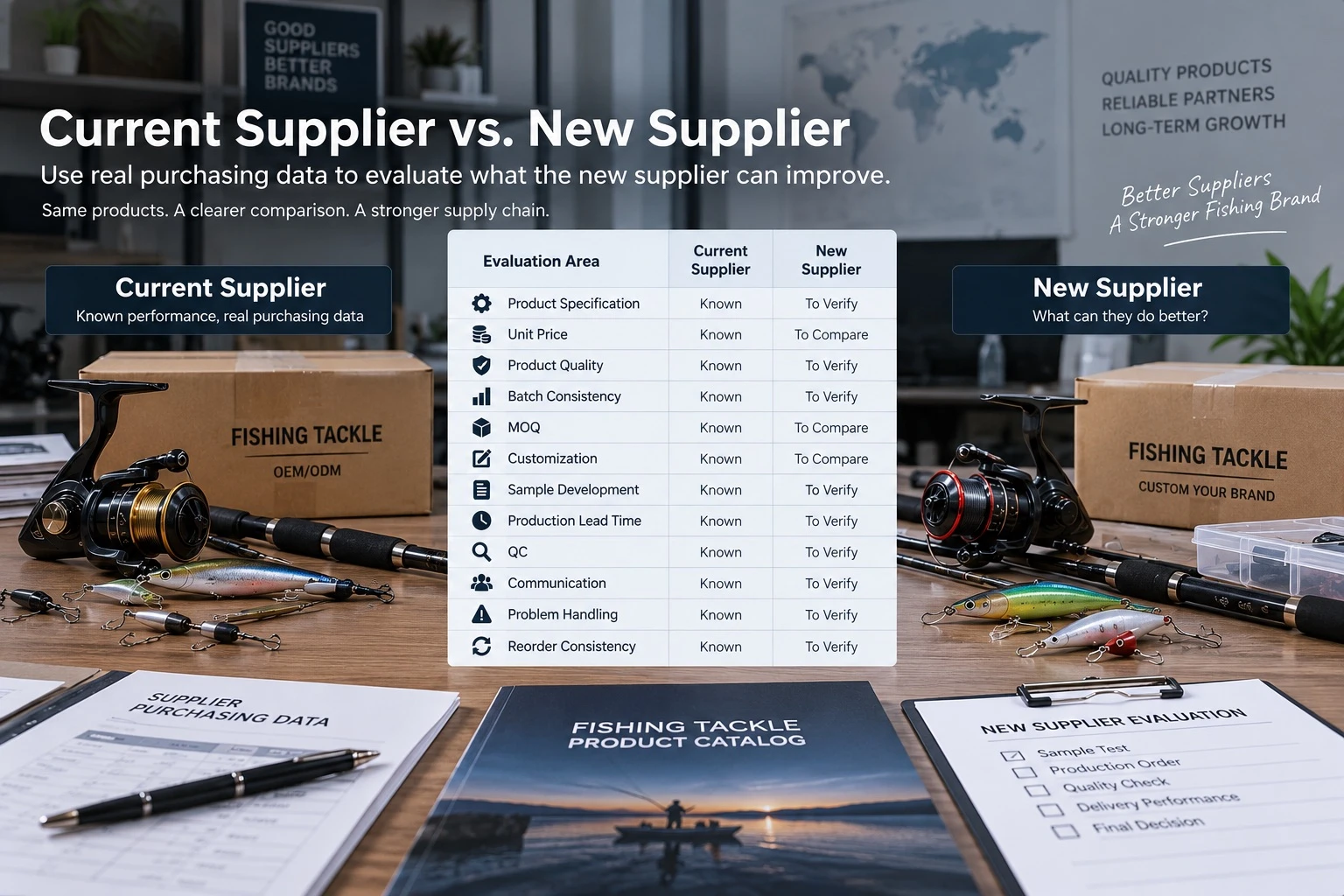
| Evaluation Area | Current Supplier | New Supplier |
|---|---|---|
| Product Specification | Known | To Verify |
| Unit Price | Known | To Compare |
| Product Quality | Known | To Verify |
| Batch Consistency | Known | To Verify |
| MOQ | Known | To Compare |
| Customization | Known | To Compare |
| Sample Development | Known | To Verify |
| Production Lead Time | Known | To Verify |
| QC | Known | To Verify |
| Communication | Known | To Verify |
| Problem Handling | Known | To Verify |
| Reorder Consistency | Known | To Verify |
This changes the evaluation from:
“Does this supplier look good?”
to:
“What specific weakness or limitation in our current supplier system does this supplier improve?”
3. Choose a Representative Product for Testing
If an established fishing brand manages dozens or hundreds of SKUs, moving many products to an unverified supplier at the same time creates unnecessary risk.
A better approach is to select a representative product or product family for the initial evaluation.
For example:
- A reel brand might select an established 3000-size spinning reel.
- A rod brand might select a proven spinning or casting rod.
- A lure brand might select a lure platform with established sales history.
An existing product is useful because the buyer already understands:
- Required specifications
- Expected performance
- Current purchasing cost
- Customer feedback
- Common quality issues
- Packaging requirements
- Acceptable quality standards
This gives you a real benchmark against which the new supplier can be evaluated.
Test one representative product family before expanding the relationship across multiple SKUs.
4. Make a Like-for-Like Product Comparison
Suppose your current supplier quotes:
$11.50
and a new supplier quotes:
$9.80
That does not automatically mean the new supplier saves $1.70 per unit.
First determine whether both quotations represent genuinely comparable products.
For fishing reels, this may require confirming:
- Body material
- Rotor material
- Main gear material
- Pinion gear
- Bearing count and locations
- Main shaft
- Drag system
- Spool
- Handle
- Bail
- Line roller
- Internal support
- Finished weight
- Saltwater protection
- Packaging
For a fishing rod, compare:
- Blank specification
- Carbon material
- Power
- Action
- Guides
- Guide layout
- Reel seat
- Handle
- Finished weight
- Finish
- Packaging
If the new supplier achieves a lower price by reducing the product specification, the quotation is not necessarily a lower cost for the same product.
Make the products comparable before comparing the prices.
For a more detailed quotation comparison process, see our How to Compare Fishing Tackle Supplier Quotations guide.
5. Pay Attention to the Questions the Supplier Asks
The questions a supplier asks can provide useful information about how well it understands your project.
For example, you may tell a supplier:
“We are looking for a 3000-size spinning reel for saltwater use.”
An immediate response of:
“Yes, we have it. Price is $XX.”
does not necessarily demonstrate a strong understanding of the application.
Depending on the project, a more complete discussion may involve:
- Target species
- Target reel weight
- Required drag
- Gear ratio
- Line capacity
- Body material
- Corrosion-resistance requirements
- Target market positioning
- Existing platform or deeper customization
- Order quantity
- Packaging requirements
This does not mean that a supplier asking more questions is automatically better.
The important point is whether those questions help clarify the product, application, and purchasing requirements.
The quality of a supplier’s questions can be as important as the quality of its answers.
6. Use Samples to Test Product Capability
A successful sample is a positive sign, but it answers only one question:
Can this supplier make the product correctly?
It does not yet answer:
Can this supplier repeatedly make the product correctly at production scale?
Fishing Reel Samples
Depending on the specification, buyers may check:
- Smoothness
- Gear feel
- Drag
- Bail
- Handle
- Spool
- Line roller
- Anti-reverse
- Assembly
- Finish
- Actual weight
- Confirmed specifications
Fishing Rod Samples
Buyers may check:
- Blank
- Power
- Action
- Guides
- Guide alignment
- Reel seat
- Handle
- Finish
- Graphics
- Finished weight
Fishing Lure Samples
Buyers may check:
- Dimensions
- Weight
- Hooks
- Hardware
- Color
- Finish
- Swimming action
- Floating or sinking behavior
- Packaging
The distinction is important:
A sample tests product capability. A production order tests repeatability.
7. Freeze the Specification Before Production
One common OEM mistake is approving a sample with a simple message such as:
“Sample approved.”
and then moving directly into production.
A stronger process is:
Do not approve only the sample. Approve the specification behind the sample.
Before production, confirm and record the relevant details, such as:
- Final product model
- Dimensions
- Weight
- Materials
- Components
- Colors
- Logo
- Artwork
- Packaging
- Hardware
- Critical tolerances where necessary
- Approved sample
The production reference then becomes:
Approved Sample + Final Specification = Production Reference
This creates a clearer standard for both the buyer and supplier.
Without documented specifications, disagreements can easily arise when a component, material, color, or other detail changes between sample approval and production.
8. Use the First Production Order as a Controlled Supplier Test
The first production order does not necessarily have to be a very small order.
The important concept is not:
Small Order
but:
Controlled First Production Order
For one buyer, a trial production quantity may be 200 pieces. For a larger importer, 500 pieces or more may still represent a controlled first order.
The objective is to avoid transferring too many products, SKUs, or too much purchasing volume before the supplier has demonstrated production capability.
The first production order should help verify:
- Product consistency
- Batch consistency
- Production discipline
- QC execution
- Packaging accuracy
- Production lead-time performance
- Communication during production
At this stage, you are no longer testing only the product.
You are testing supplier execution.
9. Compare Production Against the Approved Sample
When the first production batch is completed, do not evaluate it only by asking:
“Does the quality look good?”
Return to the:
Approved Sample + Final Specification
and ask:
Does production match what was approved?
For fishing reels, this may include checking whether the production batch maintains the approved:
- Gear materials
- Bearing configuration
- Handle
- Drag system
- Weight range
- Assembly quality
- Overall feel
For fishing rods:
- Guide specifications
- Guide layout
- Blank
- Reel seat
- Handle
- Graphics
- Finish
For fishing lures:
- Weight
- Hooks
- Hardware
- Color
- Finish
- Swimming action
The real test is:
Sample-to-production consistency
This is much more useful than simply deciding whether the finished products “look acceptable.”
10. Verify Whether QC Is Actually Executed
During supplier discussions, terms such as “Strict Quality Control” are easy to use.
The more important question is:
What happens during actual production?
For fishing reels, inspection may include:
- Rotation
- Gear operation
- Drag
- Bail
- Handle
- Spool
- Line roller
- Anti-reverse
- Assembly
- Finish
- Logo
- Confirmed specifications
For fishing rods, inspection may include:
- Blank appearance
- Guide installation
- Guide alignment
- Reel seat
- Handle
- Finish
- Graphics
- Dimensions
- Assembly
The QC method should match the product and its risks.
At Fantan Fishing, fishing rods and fishing reels undergo 100% inspection before shipment, rather than relying only on final random sampling.
11. Test Actual Lead-Time and Communication Performance
Fast responses during the quotation stage do not necessarily mean communication will remain reliable during production.
During a real order, evaluate whether:
- Pre-production details are recorded accurately
- The agreed production schedule is followed after all details are confirmed
- Problems are communicated proactively
- Specification changes are confirmed before implementation
- Potential delays are communicated early
- Uncertain information is verified before being communicated
- Packaging and shipment information is accurate
For production timing, both sides should first use the same starting point:
Production lead time starts after all production-related details are fully confirmed.
Only then can actual lead-time performance be evaluated fairly.
12. Evaluate How the Supplier Handles Problems
No buyer wants problems in an order.
Low defect rates and consistent quality should always remain the primary objective.
However, during a long-term sourcing relationship, issues can still occur in materials, components, production, packaging, or logistics.
When a problem occurs, evaluate whether the supplier:
- Acknowledges the issue
- Investigates the cause
- Provides supporting photos, videos, inspection results, or production records where appropriate
- Proposes a practical corrective solution
- Takes action to prevent recurrence
A vague response such as:
“We will pay more attention next time.”
does not provide much evidence that the root cause has been addressed.
Low defect rates matter, but problem-handling capability also matters when an issue does occur.
This does not mean quality problems should be accepted. It means corrective capability is another factor in evaluating a long-term supplier.
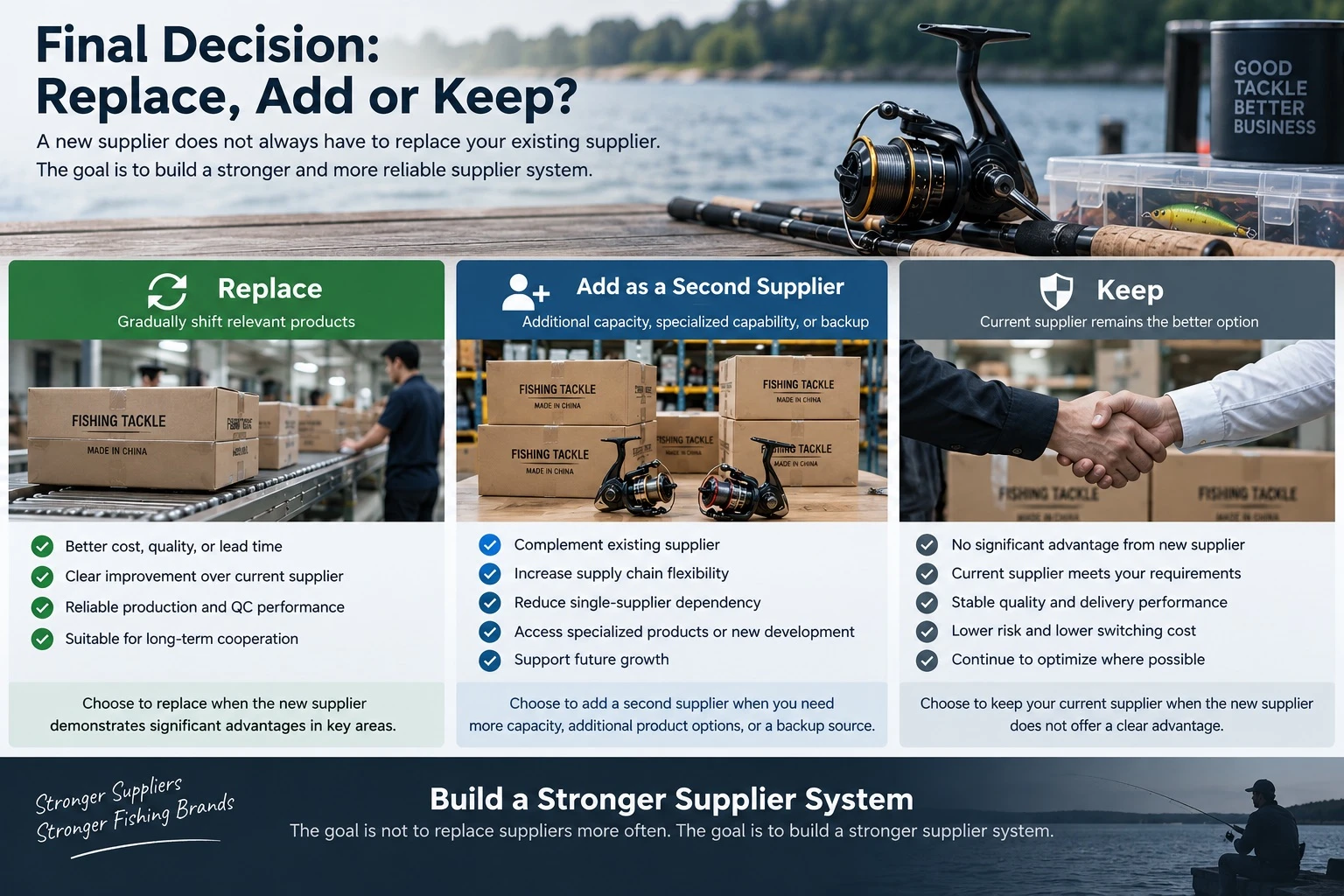
13. Make the Final Decision: Replace, Add, or Keep
After completing the evaluation, the result does not have to be simply:
Approved / Rejected
For an established purchasing operation, three outcomes are often more useful.
Option 1: Replace
If the new supplier demonstrates meaningful improvement in the areas that matter to the buyer-such as product consistency, cost, QC, lead time, development capability, or communication-it may make sense to gradually transfer the relevant products.
The important word is gradually.
One successful production order does not necessarily justify immediately moving the entire purchasing volume.
Option 2: Add as a Second Supplier
This can be an equally successful outcome.
The new supplier may:
- Be stronger in certain product categories
- Offer a more suitable MOQ
- Provide better development capabilities
- Add production capacity
- Serve as a backup source
- Handle products that are not the existing supplier’s strength
In this case, the buyer may establish:
Primary Supplier + Secondary Supplier
or allocate different product categories to different specialized suppliers.
Option 3: Keep the Current Supplier
Testing a new supplier does not mean you have to use it.
If the evaluation shows:
- No meaningful advantage
- Insufficient batch consistency
- Significant sample-to-production differences
- Unreliable lead times
- Higher communication costs
- Unexpected additional costs
then maintaining the existing supplier arrangement may still be the better decision.
The purpose of finding a new supplier is not to change suppliers. It is to improve the supplier system.
New Fishing Tackle Supplier Evaluation Checklist
| Evaluation Area | What You Are Really Testing |
|---|---|
| Reason for Change | What needs improvement |
| Product Understanding | Understanding of product and application |
| Like-for-Like Specification | Whether products are genuinely comparable |
| Quotation | Accuracy and transparency |
| Sample | Product capability |
| Specification Freeze | Documentation of the approved product |
| First Production Order | Production execution |
| Batch Consistency | Repeatability |
| QC | Actual quality-control execution |
| Packaging | Order accuracy |
| Lead Time | Production reliability |
| Communication | Accuracy and transparency |
| Problem Handling | Corrective capability |
| Reorder Capability | Long-term consistency |
| Final Decision | Replace / Add / Keep |
Conclusion
For established fishing tackle brands, importers, and wholesalers, sourcing a new supplier is often not about starting over. It is about continuously improving an existing supply chain.
A new supplier ultimately needs to prove more than:
“We can make this product.”
It needs to demonstrate:
“We can consistently reproduce the approved product at production scale and improve a meaningful part of your existing supplier system.”
A practical evaluation process therefore looks like:
Define the Improvement → Benchmark → Compare → Sample → Freeze Specification → Controlled Production → Verify → Replace / Add / Keep
The improvement may come from better cost, quality, product development, MOQ, lead time, or capacity.
Or the new supplier may simply become a reliable second source.
Both can represent successful supplier optimization.
The goal is not to replace suppliers more often. The goal is to build a stronger supplier system.
FAQ
1. Why do established fishing tackle brands look for new suppliers if they already have suppliers?
Established buyers may look for new suppliers to improve cost, quality, lead time, product development, capacity, or MOQ. They may also want a reliable second source to reduce dependence on a single supplier.
2. Should I replace my current fishing tackle supplier if a new supplier offers a lower price?
Not necessarily. First confirm that both products are being compared on equivalent specifications. Then evaluate quality consistency, MOQ, QC, lead time, communication, and overall purchasing cost.
3. Is a good sample enough to approve a new fishing tackle supplier?
No. A good sample demonstrates product capability, but a production order is needed to evaluate repeatability, batch consistency, QC execution, and delivery performance.
4. Should I move all my fishing tackle SKUs to a new supplier at once?
Usually, it is safer to begin with a representative product or product family and verify actual production performance before expanding the relationship across additional SKUs.
5.Is adding a second supplier better than replacing the existing supplier?
It depends on the objective. A second supplier can provide additional capacity, specialized product capability, and supply-chain redundancy without requiring the buyer to replace a well-performing existing supplier.
Evaluating a New Supplier for Your Fishing Tackle Products?
If you are comparing a new supplier with your current sourcing setup, send us the product specifications, target quantity, and customization requirements. We can review the requirements and determine whether an existing platform or a customized solution is suitable for your project.