
You send the same fishing reel, rod or lure requirement to three suppliers and receive three different quotations:
- Supplier A: $8.50
- Supplier B: $10.20
- Supplier C: $12.80
At first glance, Supplier A may appear to be the obvious choice.
But there is a more important question:
Are all three suppliers actually quoting the same product?
When evaluating a fishing tackle manufacturer in China, brands, importers and wholesalers should compare the product specification and quotation scope-not the unit price alone.
Differences in materials, components, customization, packaging, quality control and delivery terms can make two apparently similar quotations fundamentally different.
The goal is simple:
Make the quotations comparable first. Then compare the prices.
This guide explains how to do that.
1. Confirm You Are Comparing the Same Product Specification
This is the most important step.
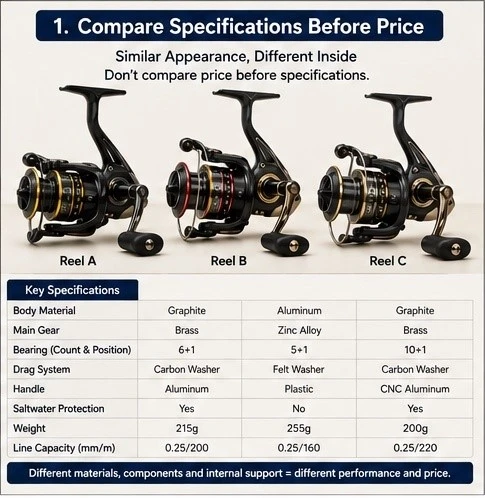
A product photo, model name or several headline specifications are usually not enough to confirm that different suppliers are quoting equivalent products.
For example, two spinning reels may both be described as:
- Size 3000
- 6+1 bearings
- 5.2:1 gear ratio
- Aluminum spool
- 10 kg / 22 lb max drag
On paper, they look similar.
Internally, however, they may use very different materials, components and support structures.
What to Compare for Fishing Reels
| Specification | What to Confirm |
|---|---|
| Body & Rotor | Graphite, reinforced graphite, carbon composite or aluminum |
| Main Gear | Material and manufacturing method |
| Pinion Gear | Material and support structure |
| Bearings | Count, type, quality and actual locations |
| Main Shaft | Material and relevant dimensions |
| Drag System | Washer material, configuration and practical performance |
| Handle | Standard, screw-in, aluminum or CNC |
| Spool | Material and construction |
| Bail & Line Roller | Material, construction and bearing support |
| Internal Support | Gear and pinion support arrangement |
| Saltwater Protection | Corrosion-resistant components, sealing or other protection |
| Weight | Actual finished weight |
| Line Capacity | Mono and/or braid capacity |
For fishing reels, internal construction and component differences can significantly affect both cost and performance.
A reel with 10+1 bearings is not automatically better than a reel with 6+1 bearings.
Bearing quality and placement, gear support, body rigidity and overall drivetrain construction are often more important than the bearing count printed on the packaging.
What to Compare for Fishing Rods
For rods, confirm:
- Blank material and carbon specification
- Length
- Power
- Action
- Number of sections
- Lure or casting weight
- Line rating
- Guide brand and material
- Guide quantity and layout
- Reel seat
- Handle material and construction
- Finished rod weight
- Surface finish and graphics
- Rod bag or other included accessories
Two rods described as 7 ft / MH / Fast should not automatically be treated as equivalent.
What to Compare for Fishing Lures
For hard lures, compare:
- Body material
- Exact dimensions and weight
- Hook specification
- Split rings
- Internal weight system
- Rattle or silent construction
- Paint process
- Color requirements
- Logo method
- Packaging
- Swimming, sinking or suspension characteristics where relevant
For soft lures, also consider:
- Material softness
- Salt content
- Scent
- Color formulation
- Glitter
- Pieces per pack
- Mold requirements
Buyer rule: Do not compare prices until the critical specifications behind those prices are clear.
2. Separate Product Cost from Customization Cost
OEM quotations can become difficult to compare because different suppliers include customization costs in different ways.
One supplier may include logo printing in the unit price.
Another may list it separately.
A third may quote only the standard product and calculate custom colors or packaging later.
A clearer comparison separates the quotation into several parts.
Base Product
The standard product itself.
Branding
Depending on the product, this may include:
- Printed logo
- Laser marking
- Engraving
- Decals
- Custom graphics
Product Customization
This may include:
- Custom colors
- Components
- Handles
- Spools
- Gear ratios
- Guides
- Reel seats
- Hooks
- Hardware
Packaging
Such as:
- Color boxes
- Blister packs
- Header cards
- PE bags
- Rod bags
- Reel boxes
- Lure packaging
- Printed inserts
- Barcodes
- Labels
One-time costs should also be separated clearly, including tooling, molds, printing plates and other development setup costs.
This helps buyers determine whether a higher quotation represents a more expensive product or simply includes more of the project scope.
3. Compare MOQ on the Same Basis
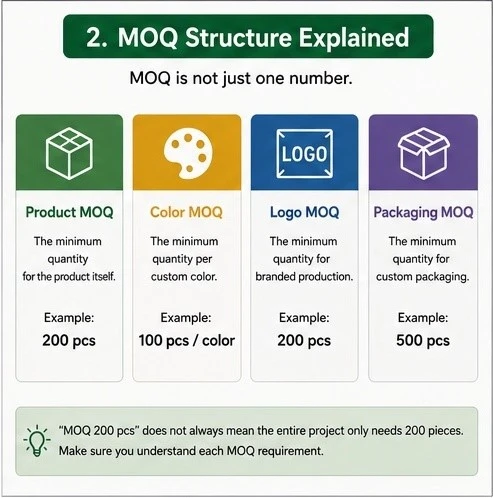
“MOQ: 500 pcs” does not always mean the same thing.
An OEM fishing tackle project can involve several different MOQ requirements.
Product MOQ
The minimum quantity for the product itself.
Color MOQ
The minimum quantity per custom color.
Logo MOQ
The quantity required for branded production.
Packaging MOQ
The minimum printing quantity for custom retail packaging.
Component MOQ
A minimum quantity created by a specific customized component.
For example:
Product MOQ: 200 pcs
Custom Color MOQ: 100 pcs/color
Custom Packaging MOQ: 500 pcs
This is very different from a quotation that simply states:
MOQ: 200 pcs
Buyers should ask suppliers to separate these requirements clearly.
This becomes especially important when a brand is planning multiple sizes, colors or SKUs.
A low headline MOQ can still create substantial inventory exposure once all variations are included.
4. Compare Sample Terms Before Bulk Pricing
A supplier should not be evaluated only by the mass-production unit price.
In OEM fishing tackle manufacturing, the sample process can reveal a great deal about how the supplier handles product development.
- Sample price
- Sample quantity
- Existing sample vs customized sample
- Logo customization
- Color customization
- Component changes
- Sample lead time
- Sample shipping cost
- Revision requirements
- Whether a pre-production sample is required
More importantly, ask:
What does the sample actually represent?
An existing stock sample can help evaluate basic construction, feel and performance.
However, it may not represent the final branded production specification.
For more customized projects, the final approved sample should become an important reference for mass production.
Sample Charges, Tooling Costs and Shipping
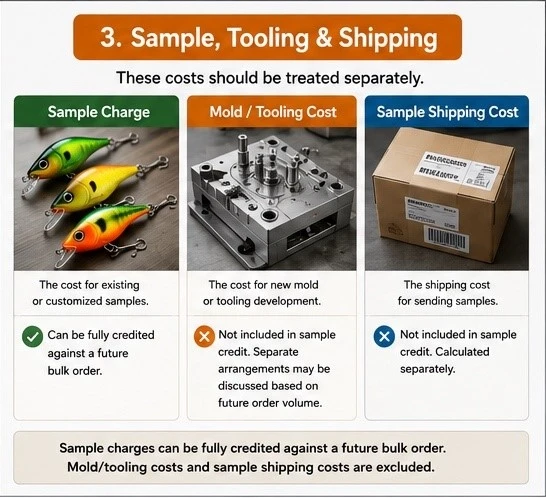
These costs should be treated separately.
At Fantan Fishing, sample charges can be fully credited against a future bulk order.
However, this does not include:
Sample shipping costs
Mold costs
Tooling costs
For some custom development projects, separate tooling cost arrangements may be discussed based on future order volume.
This should be confirmed project by project rather than assumed to be part of the normal sample credit.
5. Compare the Actual Quality Control Standard
“Strict Quality Control” is not enough information for a meaningful supplier comparison.
Buyers should ask:
What is inspected, and how is it inspected?
Typical Fishing Reel Inspection Points
These may include:
- Rotation and smoothness
- Gear operation
- Handle assembly
- Spool operation
- Bail function
- Drag operation
- Line roller
- Anti-reverse
- Surface finish
- Logo and graphics
- Assembly
- Confirmed specifications
Typical Fishing Rod Inspection Points
- These may include:
- Blank appearance
- Guide installation
- Guide alignment
- Reel seat
- Handle assembly
- Surface finish
- Graphics
- Dimensions
- Overall assembly
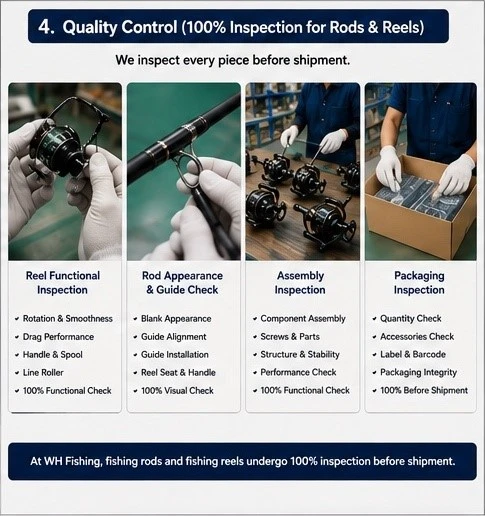
Buyers should also confirm the inspection method.
Is the order inspected by:
- Random sampling?
- Functional testing?
- 100% inspection?
At Fantan Fishing, fishing rods and fishing reels undergo 100% inspection before shipment, rather than relying only on random final sampling.
The inspection items vary according to the product and confirmed specification.
A lower quotation based on a different QC standard should not automatically be treated as a lower price for the same supply scope.
6. Confirm When the Production Lead Time Actually Starts
This is one of the most commonly misunderstood parts of an OEM quotation.
Suppose two suppliers both quote:
Production Lead Time: 35 Days
That does not necessarily mean their actual delivery schedules are the same.
The buyer should ask:
What must be fully confirmed before the quoted production lead time starts?
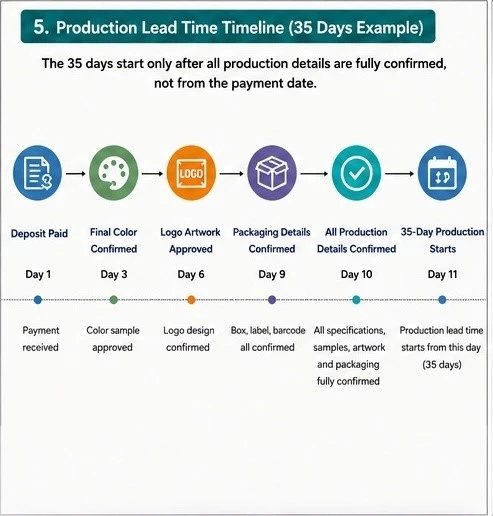
For OEM fishing tackle projects, the production lead time starts after all production-related details are fully confirmed.
Depending on the project, this may include:
- Final product specifications
- Components
- Colors
- Logo artwork
- Packaging artwork
- Labels or barcodes
- Required samples
- Other customization details
For example:
| Stage | Timing Example |
|---|---|
| Deposit Paid | Day 1 |
| Final Color Confirmed | Day 3 |
| Logo Artwork Approved | Day 6 |
| Packaging Details Confirmed | Day 9 |
| All Production Details Confirmed | Day 10 |
| Production Lead Time | Following 35 days |
In this example, a quoted 35-day production lead time does not mean shipment 35 days after payment.
The 35 days start only after all production details have been fully confirmed.
This is why buyers should compare:
Pre-production confirmation time + Production lead time
rather than comparing only “30 days” versus “35 days.”
7. Normalize Incoterms and Shipping Costs
A quotation of:
$9.50 EXW
cannot be compared directly with:
$10.20 FOB
because the two prices include different responsibilities and costs.
Depending on the Incoterm and shipping arrangement, additional costs may include:
- Domestic transportation
- Export handling
- Port charges
- Ocean or air freight
- Insurance
- Customs clearance
- Import duties
- Taxes
- Destination delivery
When comparing international fishing tackle quotations, record at least:
Unit Price + Incoterm + Named Place/Port + Freight + Relevant Additional Costs
If the goal is to understand the real inventory cost, buyers should calculate the estimated:
Landed Cost Per Unit
This is often more useful than comparing factory prices alone.
8. Compare Payment Terms and Commercial Conditions
Payment terms influence both cash flow and purchasing risk.
Compare:
- Deposit percentage
- Balance percentage
- When the balance becomes due
- Payment method
- Currency
- Bank or transaction charges
- Quotation validity
- Conditions that may cause a price adjustment
For example:
Supplier A:
50% deposit + 50% before shipment
Supplier B:
30% deposit + 70% before shipment
Even if the product price is identical, the working-capital requirement is different.
This becomes increasingly important as purchasing volumes grow.
9. Compare After-Sales Support and Reorder Consistency
A supplier relationship does not end when the first shipment leaves China.
For established brands, importers and wholesalers, consistency across repeat orders can be more important than saving a small amount on the first purchase.
Ask:
- How are defects handled?
- Are replacement parts available?
- Can the same materials and components be maintained for future orders?
- Will component changes be communicated before production?
- Are approved colors and specifications recorded?
- Can packaging artwork be reused?
- What happens if a component becomes unavailable?
- Can production capacity increase if sales grow?
For branded fishing tackle, this matters particularly.
Once customers associate a certain rod, reel or lure with your brand, uncontrolled specification changes between production batches can create much greater costs than a small difference in purchase price.
10. Build a Side-by-Side Supplier Quotation Comparison
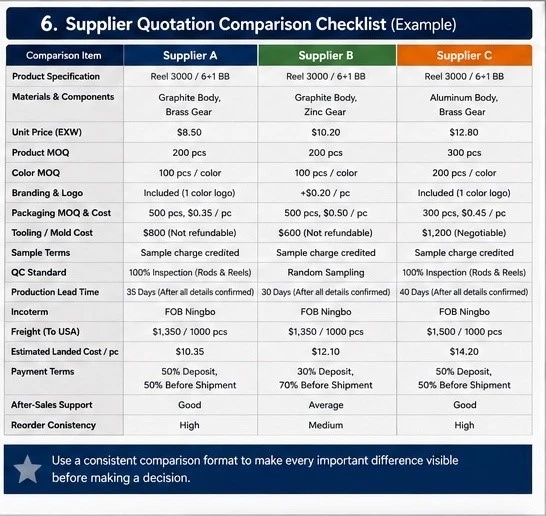
Once the technical and commercial details are clear, place all suppliers into the same comparison format.
| Comparison Item | Supplier A | Supplier B | Supplier C |
|---|---|---|---|
| Product Specification | |||
| Materials | |||
| Key Components | |||
| Unit Price | |||
| Product MOQ | |||
| Color MOQ | |||
| Branding Cost | |||
| Packaging MOQ & Cost | |||
| Tooling / Mold Cost | |||
| Sample Terms | |||
| QC Standard | |||
| Pre-Production Requirements | |||
| Production Lead Time | |||
| Incoterm | |||
| Freight | |||
| Estimated Landed Cost | |||
| Payment Terms | |||
| After-Sales Support | |||
| Reorder Consistency |
The purpose is not to create an overly complicated scoring system.
The objective is to make every important difference visible before making a purchasing decision.
The Lowest Quote Is Not Always the Lowest-Cost Option
A fishing tackle quotation should be evaluated as a combination of:
Product + Specification + Customization + Quality Control + Commercial Terms + Delivery
– not simply a unit price.
If the specifications, quality standards and commercial conditions are genuinely equivalent, a lower price may represent better purchasing value.
However, if two quotations are based on different materials, components, QC requirements, packaging or delivery conditions, the unit price difference alone tells you very little.
For fishing brands, importers and wholesalers, the better approach is:
Make the quotations comparable first. Then decide which differences are worth paying for.
This creates a stronger basis for supplier selection, sample development and long-term purchasing.
FAQ
1. How should I compare quotations from different fishing tackle suppliers?
First confirm that all suppliers are quoting the same product specifications, quantities and customization scope. Then compare MOQ, sample terms, QC standards, production lead time, Incoterms, shipping costs, payment terms and after-sales support.
2. Why do fishing tackle suppliers quote very different prices for similar products?
Products that look similar can use different materials, components, manufacturing processes and QC standards. For fishing reels, differences in gears, bearings, body materials, drag systems and internal support can significantly affect both cost and performance.
3. Should I choose the fishing tackle supplier with the lowest unit price?
Not automatically. If the specifications and commercial conditions are genuinely equivalent, the lower price may offer better value. The key is to make sure you are comparing equivalent products and quotation scopes first.
4. When does OEM fishing tackle production lead time start?
Production lead time starts after all product specifications, customization details, artwork, packaging, required samples and other production-related details have been fully confirmed. It does not simply start from the payment date.
5. Can fishing tackle sample charges be credited against a bulk order?
At Fantan Fishing, sample charges can be fully credited against a future bulk order. Sample shipping costs and mold or tooling costs are excluded. For some custom development projects, separate tooling arrangements may be discussed based on future order volume.
Comparing Fishing Tackle Quotations for Your Next Project?
If you are evaluating fishing reels, rods, lures or other tackle for your brand, send us your target specifications, quantity and customization requirements. We can help you clarify the specification before preparing a quotation.